Sunday, 5 January 2014

Log Thirty Five: 'A Critical Reflection on Professional Inquiry'

Introduction

Now I have critically reflected on Module Three – Professional Inquiry - I feel I have enjoyed the experience of doing my professional inquiry, creating my professional artefact, and critically reviewing the findings of my professional inquiry on "How do teachers foster the development of independent learners in a special educational needs (SEN) context?".

Part One - “Professional Inquiry”

Starting Module Three I quickly realised that after reading the feedback from my academic advisor I need to amend my professional inquiry - something I wasn't keen on as I didn't particularly enjoy Module two - Developing lines of inquiry. Immediately I dived straight in with what needed to be amended before carrying out my professional inquiry on  on "How do teachers foster the development of independent learners in a special educational needs (SEN) context?"creating and developing my own questions on transitions a child experiences in primary school. After I reflected upon my professional inquiry findings and started on my literature reviews.

Part Two - “Critical Review”

The critical review of Module three was something I found to be a bit of a challenge  but enjoyable at the same time. I found it to be a challenge because as while I feel my professional inquiry has deepened my own understanding the process of evaluating and analysing were challenging.

Part Three - “Professional Artefact”

I greatly enjoyed creating my Professional Artefact on "How do teachers foster the development of independent learners in a special educational needs (SEN) context?". I had always planned on using the professional artefact as part of my oral presentation  and after contacting my academic advisor where they confirmed that it should be only used as part of the oral presentation if it relates to your findings. I chose to do it in a video format as it's a type of presentation I am comfortable with.

Conclusion

Upon reflection I feel while I have tried my best to adapt to new ways of critically reflecting and sharing my findings through blogs to be engaged with my peers along my BAPP journey. During my BAPP journey I have learnt how in the future I can best make use of my own professional network, how critical thinking involves consistent focus and attention to detail. I feel that the skills I have learnt on the course will help greatly in the future for my self-development on chosen career path.

Log Thirty Four: Literature Review Two - "Individual Education Plan (IEP)"

In this article the author talks about the importance of individual education plans (IEP) for special educational needs (SEN) children. I chose this article because of my huge interest in working with special educational needs children with a view of expanding my own professional understanding of individual education plans.


"WHAT IS AN IEP?
An IEP or Individual Education Plan is a plan or programme designed for children with SEN to help them to get the most out of their education. An IEP builds on the curriculum that a child with learning difficulties or disabilities is following and sets out the strategies being used to meet that child’s specific needs.

An IEP is a teaching and learning plan and should set out targets and actions for the child that are different from or additional to those that are in place for the rest of the class. The IEP is not a legal document, which means that the LEA does not have to produce a plan or make sure that a child receives any support that is outlined in the plan."


The author states that an individual educational plan is specially designed for an SEN child's specific needs. In my own experience as a special education needs learning support assistant (SEN LSA) my job role requires me to carry out the IEP for SEN child I am tasked with looking after.


"WHAT IS THE PURPOSE OF AN IEP?
The purpose of an IEP is to inform the teacher and others working with the child of specific targets for the child and how these will be reached. The IEP allows schools and staff to plan for progression, monitor the effectiveness of teaching, monitor the provision for additional support needs within the school, collaborate with parents and other members of staff and help the child become more involved in their own learning and work towards specific targets."

At my primary school it's the role of the special educational needs co-ordinator (SENCO) and class teacher to decide what additional needs the SEN child requires in the form of interventions to reach the next stage of their learning development.


"WHAT IS IN AN IEP?
An IEP should contain "targets", "provisions" and "outcomes". It should note 3 or 4 short-term targets set for or by the child, the teaching strategies to be used to achieve those targets, the provision that will be put in place, say when the plan is to be reviewed and identify outcomes which show the child’s progress against his/her previous targets.

Information that may be contained in an IEP may include:

  • Any likes, dislikes or anxieties that the child may have
  • Assessment information
  • Details of any other educational plans the child may have
  • Details of how the IEP will be co-ordinated
  • Details of the child’s additional support needs
  • Details of who will be providing the support
  • Home-based tasks and the parents’ and child’s comments
  • Information and timescales for reviewing the IEP
  • Targets that the child is expected to achieve within a specified period of time
  • Parents and child’s details.

Targets set in the IEP should be "SMART", which stands for: 

Specific, so that it is clear what the child should be working towards
Measurable, so that it is clear when the target has been achieved
Achievable, for the individual child
Relevant, to the child’s needs and circumstances
Time-bound, so that the targets are to be achieved by a specified
  time"


Upon reading this article I stumbled upon the term 'SMART' and as I hadn't heard of the term I contacted friends of mine in my professional network to seek more understanding and whether they find it effective.

"REVIEWING AN IEP
The IEP is a working document and should be reviewed regularly (usually two or three times a year) to ensure that it continues to meet the child’s needs. When reviewing IEPs teachers need to consider both the parents' and the child’s views, the progress made by the pupil, the effectiveness of the IEP, any specific issues that impact on the child’s progress and any changes to targets or strategies. After considering the child’s current progress, new targets should be set to be achieved by the next IEP review."

In my experience as a special education needs learning support assistant I have found that when starting a new IEP set by the special education needs co-ordinator, class teacher and parents it's important to explain to the SEN child the new interventions they will be doing and positively explaining how they have progressed to the next level to help build their own self confidence. I have also found in my experience that a SEN child's IEP normally consists of three or four individual targets in certain areas such as communication, literacy, numeracy or behaviour and social skills. Thanks for reading.


Thursday, 2 January 2014

Log Thirty Three: Literature Review One - "Independent Learning: What role does the teacher have to play?"

Dated 23rd May 2011, In this blog post the author talks about the importance of the role the teacher plays on promoting independent learning inside and outside the classroom. 

“Independent learning is a process, a method and a philosophy of education whereby a learner acquires knowledge by his or her own efforts and develops the ability for enquiry and critical evaluation”

The author states that independent learning is a journey a child goes on enhance their own understanding at a pace the child doesn't get 'lost' by too much information thus being unable to keep up with their peers.


Adapted Teaching
"A drive for independent learning within and beyond the classroom certainly means a change in role from the teacher.  With more emphasis on learners taking responsibility for their learning the teachers’ role becomes one of leader rather than controller of learning"

Teacher's have to be willing to adapt their lesson plans whilst also implementing independent learning strategies.

Teacher's Role
"Teacher as facilitator, mentor, coach and guide:
Teachers are able to help learning in a myriad of ways and these will vary with every lesson and every student, but some key ways that teachers can act as facilitator, mentor, coach and guide are by:
·        Providing learners with resource materials
·        Whetting learners appetites to learn
·        Providing learners with opportunities to test out their learning
·        Giving learners feedback on their progress and
·        Helping learners to make sense of what they have learned"

The author explains that the role of the teacher changes from a rigid role to a fluid role aimed at positively coaching and impacting the learning development of every child inside and outside the classroom.


Advantages of Independent Learning
"What’s so great about Independent Learning anyway?
Directed learning, or teaching to the test usually results in pupils passing the exams and jumping through the hoops that the educational system requires of them.  But it doesn’t prepare them at all for life beyond the classroom – and in most cases it squeezes out any passion, enjoyment or spark they might have had for learning in the first place.
Independent learners have abilities that will stand them in good stead both during and beyond their education such as their ability to:
·        Acquire and deploy information
·        Communicate effectively using different media
·        Organise themselves
·        Problem solve and
·        Relate to others"

The author argues the advantages of independent learning and makes valid points on how it best prepares them to make choices outside school.


Examples of Independent Learning
"How to promote Independent Learning:
One of the most important roles of the teacher is to promote independent learning.  There are a number of practices you can build into your teaching to encourage independent learning during every lesson.  These include:
·        Giving pupils choices so they can reflect on their own interests and preferences
·        Encouraging group work so that learners can learn from each other
·        Collaborate with pupils to set shared learning goals
·        Involve pupils in lesson planning
·        Encourage pupils to reflect and plan" 

In my own experience as a special educational needs learning support assistant (SEN LSA) I have witnessed teachers promoting independent learning through 'jobs' such as: register monitors, one child to count how many children are in, lights on monitors, light off monitors, advent calendar, handing out books, having a worker of the day for a child who had worked hard the previous day and the teacher allowing the whole class to come up with classroom rules.

Summary
"Independent Learning needs teachers too!
So in short, the teacher doesn’t become redundant once independent learning becomes firmly embedded.  In fact, quite the contrary is true.  The teacher’s role becomes more important than ever.  It does, however, change beyond all recognition"

To summarise I picked this blog post as my literature review as I believe this blog post on the importance of a teacher's role in implementing independent learning is significant to my professional inquiry on "How do teachers foster the development of independent learners in a special educational needs (SEN) context?". It argues the advantages of how the implementation of independent learning impacts the learning development of all children and how crucial the role of the teacher plays the part of "... facilitator, mentor, coach and guide:". Thanks for reading.


Log Thirty Two: Task 7A - Professional Inquiry


Having tweaked and edited my inquiry proposal numerous times, I decided that my inquiry should be on "How do teachers foster the development of independent learners in a special educational needs (SEN) context?".  I chose this line of inquiry because of my aspiration to become a primary school teacher and independent learning with SEN children is something that greatly interests me. I carried out my professional inquiry in late November and am in the process of completing my critical review and professional artefact thus nearly completing my BAPP journey. Thanks for reading. 

Friday, 8 November 2013

Log Thirty One: Praise and Encouragement

There are four main practices used to praise and support children:

1. Verbal - Positive comments,  award assemblies.
2. Non-verbal - thumbs up, sign language and smiling.
3. Symbolic - Stars or smiley faces.
4. Written - award certificates, positive written comments.


How do you manage a child experiencing failure and disappointment who rejects your efforts at praising them for taking part? How do you get that right balance when using  praise to ensure that, a child doesn't get uninspired from hearing the same thing constantly? These questions will be hopefully answered when I carry out my professional inquiry. Thanks for reading.

Log Thirty: Task 4D - Award Title (Update)


Proposed award title: BA (Hons) Professional Practice (Inclusive Practice)


Thanks for reading.

Log Twenty Nine: Module Three - 'Professional Inquiry'


After taking a break from the BAPP course I'm really looking forward to this module because I am interested in producing a professional inquiry that is going to challenge me and hopefully help me in my chosen career path as a primary school teacher. Whilst incredibly busy (like everyone) I will try my best to keep blogging and engage with my peers. At the moment I'm in the process of critically reading my inquiry making sure it's in the best shape it can be for carrying out my inquiry in two weeks. Thanks for reading.

Log Twenty Eight: A Teenager Brings His Class To Tears Just By Saying A Few Words


I thought I'd share this because this video is truly emotional and inspirational. Thanks for watching.

Friday, 4 January 2013

Log Twenty Seven: ‘A Critical Reflection on Principles of Professional Inquiry’


Introduction

Now I have critically reflected on Module Two – Principles of Professional Inquiry - I feel I have struggled to get as engaged in Module Two on the Principles of Professional Inquiry as I was in Module One in Establishing Professional Practice. However, I feel I have learned valuable aspects about designing a work based inquiry proposal.

Part One - “Developing Lines of Professional Inquiry”

Starting the module later than planned I quickly realised that this module would be much harder after I had read Reader One on Developing Lines of Professional Inquiry. Immediately I dived straight in with creating and developing my own questions on transitions a child experiences in primary school. After I reflected upon my questions and having a burning passion to become a primary school teacher I proposed that my award title be “BA (Hons) Professional Practice (Arts) Of Inclusive Teaching and Learning in Primary Education”. I feel my valuable experience of inclusion I learned at my previous placement (Chickenshed Theatre Company) and putting it into practice shaped my decision.

Part Two - “Professional Ethics and Tools of Professional Inquiry”

Having read Reader Two on Professional Ethics I was intrigued at the thought process one goes through in promoting good behaviour. Immediately I felt I could relate to this thought process working at school. I always thought it was common sense to ‘treat others how you wish to be treated’ which creates the foundations of what I believe to be the ethos of inclusive teaching.

Part Three - “My Learning Journey”

I feel at the start of the BAPP course I was actively engaged in blogging about my experiences in professional practice. However, since returning to my studies from my break I have struggled to recapture engaging with my peers and blogging about my journey on the BAPP course. I feel the knowledge I have gained from my learning journey on the course will help me develop my critical thinking in my professional practice because it has opened a door to way of thinking I never considered at work. Whilst I always maintain an inclusive approach to my work I never questioned why I did it and why others didn’t because it came naturally to me.

Conclusion

Upon reflection I feel while I have tried my best to be engaged in this module following my late start that I need to be more motivated to blog and interact more with my peers. I also feel I need to be more assertive and feel more confident in sharing my experiences with my peers. I will definitely look to take what I have learned and what I have identified I need to improve on to Module Three.

Friday, 28 December 2012

Log Twenty Six: Task 4A – Professional Inquiry Questions (Part Two)


Q1. "How does a special education needs learning support assistant (SEN LSA) impact a child’s learning development inside and outside the classroom?"


Q2. "Why is it important to identify a child going through a transition? And how does it affect their development?"


Q3.  "How does praising a child’s effort and success help others focus on what they are good at?


Q4. "Why is it important to be consistent about classroom rules when promoting positive behaviour?"


Thursday, 27 December 2012

Log Twenty Five: Task 6D – Delicious


Log Twenty Four: Task 5A - Codes of Practice


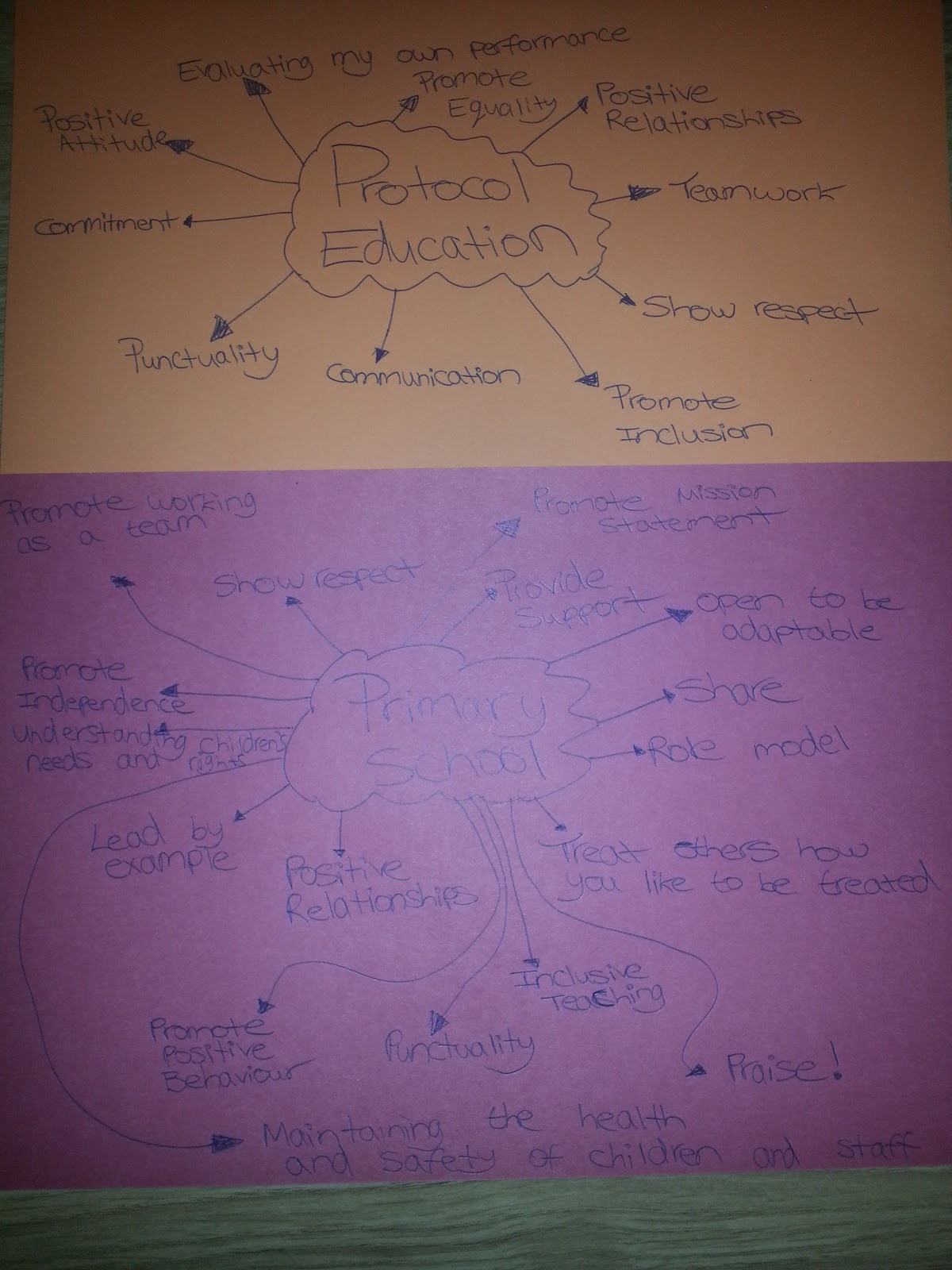
Having read Reader 5 on Professional Ethics I found this to be an interesting task. I found it easier to brainstorm the codes of practice I saw at my place of work.


My initial thoughts, having evaluated my own performance on a random day, I considered how I could improve certain aspects such as ensuring children do not think that their need is greater than others. As I have mentioned  in Log Twenty Four: Transitions  the child I work with has a lot of behavioral ‘obstacles’ and sometimes would interrupt the whole class just to be heard. I will develop this thought process and expand on it in my professional inquiry proposal. Thanks for reading.

Log Twenty Three: Transitions


As an SEN LSA in a primary school I am working one to one with a child who has Attention Deficit Disorder (ADD) and for me I always go through everyday transitions. I go through a state of mind where I know that I have to slow down my speech for SEN children that will take what you say literally. When a child starts at a new school midway through term, it’s teacher and LSA’s responsibility to identify the transition of moving schools because of a special circumstance e.g. bullying in old school, parents being divorced, new family member. Recently, I have been able to identify numerous children going through different transitions that could affect their educational development so to counter this we encourage a child going through a transition to build positive relationships with their peers. I hope to touch more on this in my inquiry proposal. Thanks for reading. 

Log Twenty Two: Independent Learning


In my primary school we work very hard to develop independent thinkers through teaching. Within my role as an SEN LSA I have been able to identify independent learning in the classroom. The class teacher has given every child a ‘job’. We have jobs for the following:
·         Answering the telephone
·         Sharpening pencils
·         Register monitors
·         To count how many children are in after the register is taken
·         To turn on the lights
·         To turn off the lights
·         Handing out books
I believe this encourages the children learn independently as well as taking ownership and responsibility with something within the classroom. I feel that providing children with opportunities develops their independent learning helps build their self confidence and positive relationships with their peers. This video clip shows the ‘the ethos of independence’ at a primary school. Thanks for reading & watching.

http://www.tes.co.uk/teaching-resource/Independent-Learners-A-Classroom-Approach-Primary-6084061/

Thursday, 22 November 2012

Log Twenty One: Task 4D – Award Title


I have acknowledged that due to my strong passion of working with children at my primary school I have been able to learn about different teaching styles and how children react to them. I have identified the area of ‘inclusive teaching and learning in primary education’ to be my main focus. In the capacity of a special education needs learning support assistant (SEN LSA) I am able to maintain and support the inclusive teaching in school. The valuable experience I am gaining will help me with my chosen career path as a primary teacher. Therefore I am proposing my award title to be the following:

BA (Hons) Professional Practice (Arts) of Inclusive Teaching and Learning in Primary Education

Thanks for reading.

Tuesday, 13 November 2012

Log Twenty: Task 4A – Professional Inquiry Questions (Part One)


Having reflected on issues which have emerged in school has led me to question how a professional in the education sector would analyse their own performance. I plan to ask, record and critically reflect upon and share my thoughts through blogging. The following questions are ones I have decided to ask professionals inside my education network:

Q1. "How does a special education needs learning support assistant (SEN LSA) impact a child’s learning development inside and outside the classroom?"

Q2. "Why is it important to identify a child going through a transition? And how does it affect their development?"

Q3.  "How does praising a child’s effort and success help others focus on what they are good at?

Q4. "Why is it important to be consistent about classroom rules when promoting positive behaviour?"

Thanks for reading.

Log Nineteen: Protocol Education

As I mentioned in Module Two – Principles of Professional Inquiry I am currently working for Protocol Education. Protocol Education is a teaching recruitment agency for which schools across the UK use as a resource and increasing their networks. Within my role at Protocol Education I am placed with a consultant whose role is to help me find work at a primary school. I am currently working at a primary school in Essex within the role of a Special Educational Learning Support Assistant (SEN LSA).

As part of my role as a SEN LSA I am tasked with looking after a child who finds it difficult to follow instructions. At the end of each day I am constantly evaluating my own performance of what I could have done differently and how I can improve. Many questions have started to emerge during my time there. 


Thanks for reading.


Log Eighteen: Module Two – Principles of Professional Inquiry


After taking a break from my studies and having read Reader 4 on Developing Lines of Professional Inquiry I am interested in developing my critical thinking and understanding the thought process of how a teacher plans, adapts and reflects upon their lesson planning and use of teaching/learning support assistants through my work with Protocol Education. Through different methods of observing, actively taking part and recording I will be able to start my professional inquiry. 


Thanks for reading.

Wednesday, 30 November 2011

Log Seventeen: Task 1A - Professional Profile (Final Draft)


I am currently studying a Bachelor of Arts degree in Professional Practice at Middlesex University. During my time at Chickenshed Theatre Company I have gained valuable experience of being patient and flexible when working with a diverse group of children, teenagers and young adults, adults and the elderly of different abilities in an inclusive manner, including medical, speech and communication, emotional, psychological and behavioural and some physical disabilities.

Having studied the Chickenshed Theatre Company’s unique and embracing philosophy in theatre I am able to use my experience and education to engage my team members and perform in an liberal manner by taking an open and professional approach to my work. My attitude towards work is of a positive nature as I have a willingness to learn and develop new skills by retaining a “can do” attitude. I have been involved in a number of projects with children in an educational and social setting. During these educational and social outreach projects I have taken on different roles of working with children such as; one to one support worker, group support leader, and session leader.

As well as my practical responsibilities during the workshops I have also planned the workshops adjusting them to meet every child’s needs and keeping our options open so that we can adapt effortlessly if need be. I believe my strengths are being able to work in a team in a professional manner, multicultural sensitivity as I have wide range of friends of different ethnic backgrounds, and goal-setting so that I complete tasks within an allotted timeframe. My dream is to use my experience I have gained from working in different educational and social environments to help me to continue my training to becoming an inclusive primary teacher.

Log Sixteen: Task 2D - Inquiry

  • Question 1 - What in your daily practice gets you really enthusiastic to find out more about? Who do you admire who also seems to love this or is an example of what you love?

 I am enthusiastic and motivated of learning new styles of teaching and learning. I think it’s also important to acknowledge and reflect upon how you've learned new skills during your own unique and interesting journey and I am always excited in sharing skills I have learned as well as establishing positive relationships with children and promoting inclusion.
 I am also inspired by notable teachers such as Erin Gruwell who made her classroom a home for her students and fiercely believed in her class of having a freedom of being themselves. In Year 9 at my Secondary School my drama teacher, Mrs Norgrove, had just started teaching at the school and before she had arrived I didn’t have any interest in performing arts, however she changed my perception and gave me the courage and confidence to express myself through use of drama. Having spent some time to reflect upon her unique teaching style I discovered that while she taught with passion, her main focus was to build confidence in her pupils in and outside of the classroom.


  • Question 2 – Who do you admire who also works with what makes you enthusiastic?

Mary Ward and Jo Collins as having worked with them for nearly five years their philosophy on inclusive teaching and learning is something I am deeply passionate about. Having co-founded Chickenshed Theatre Company in 1974 together they have ensured that there is an unshakeable foundation of acceptance for anyone with a love and passion to perform. I feel they have pioneered the ideal of inclusive theatre regardless of age, gender, race, backgrounds, sexual orientation or disability.


  • Question 3 -What gets you angry or makes you sad?

Negativity, in all forms (Bullying, Discrimination, narrow minds, selfishness, racism, ageism and sexism). I find it quite sad and upsetting seeing someone making someone else feel bad because they have achieved a good mark in their work or vice versa. I rarely get angry as I feel a cool head will always prevail so whenever a negative situation occurs I merely question the motives of the individual or group rather than get angry. 


  • Question 4 - What do you love about what you do?

I love establishing rapport and trusting and respectful relationships with children through theatre and in a classroom. I also love going through the motions of seeing how a child uses their imagination to tell a story through an action or simply by their facial expression.


As part of my involvement with Chickenshed Theatre Company I have been working as part of the support team in Children’s Theatre, "Tales from the Shed", and their Christmas production – "Cinderella". The following questions have been raised during my reflective journal writing:

  1. How do children develop their self-confidence through use of their imagination in an inclusive theatrical environment?
  2. How do children identify themselves within a primary school environment?
  3. Will bullying at school ever stop?
Thanks for reading and watching.